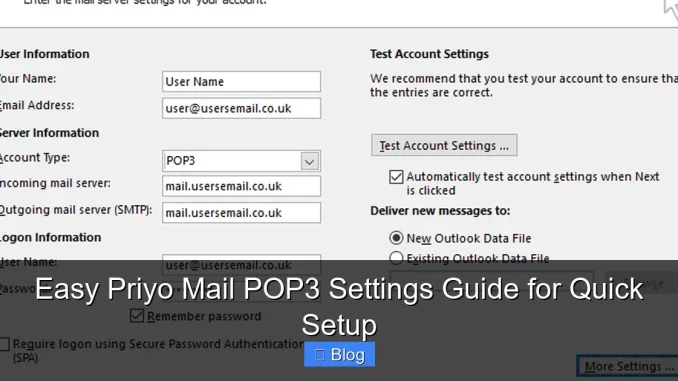
Setting up Priyo Mail with POP3 doesn’t have to be complicated. This guide walks you through every step to get your emails syncing quickly and securely on any device or email client.
This is a comprehensive guide about priyo mail pop3 settings.
Key Takeaways
- POP3 allows offline access: Download emails to your device and read them without an internet connection.
- Use the correct server settings: Incoming server is pop.priyomail.com, port 995 with SSL enabled.
- Outgoing server (SMTP) is required: Use smtp.priyomail.com, port 465 or 587, with authentication.
- Enable two-factor authentication: Adds an extra layer of security to your Priyo Mail account.
- Test your setup after configuration: Send a test email to confirm everything works properly.
- Backup your emails regularly: Since POP3 downloads and may delete from the server, keep local backups.
- Use app-specific passwords if needed: Some clients require these instead of your regular password for security.
[FEATURED_IMAGE_PLACEHOLDER]
Why Use POP3 with Priyo Mail?
If you’re a Priyo Mail user looking to access your emails on multiple devices or through third-party email clients like Outlook, Thunderbird, or Apple Mail, configuring POP3 is a smart move. Unlike IMAP, which keeps your emails synced in real time across devices, POP3 downloads your messages directly to your device. This means you can read, organize, and manage your emails even when you’re offline—perfect for travelers, remote workers, or anyone who values privacy and control over their inbox.
Many users prefer POP3 because it reduces clutter on the server. Once emails are downloaded, they’re often removed from the Priyo Mail server (though this behavior can be customized). This helps keep your online mailbox clean and improves performance, especially if you receive a high volume of messages. Plus, since your emails are stored locally, you’re less dependent on internet connectivity and server uptime.
However, it’s important to understand that POP3 isn’t perfect for everyone. If you frequently switch between devices—like checking email on your phone, laptop, and tablet—IMAP might be a better fit. But if you mainly use one primary device and want full control over your email storage, POP3 with Priyo Mail is a reliable and efficient choice.
Understanding POP3 vs. IMAP: Which Is Right for You?
Before diving into the setup process, let’s clarify the difference between POP3 and IMAP—two common protocols used to retrieve emails. POP3 (Post Office Protocol version 3) downloads your emails from the server to your local device. Once downloaded, the messages are typically deleted from the server unless you configure your email client to leave a copy. This makes POP3 ideal for users who want to store emails locally and reduce server storage usage.
On the other hand, IMAP (Internet Message Access Protocol) keeps your emails on the server and syncs them across all your devices. Any changes you make—like marking an email as read or moving it to a folder—are reflected everywhere. IMAP is great for people who check email from multiple devices and want a consistent experience.
So, which should you choose for Priyo Mail? If you’re using a single device and want offline access with minimal server dependency, go with POP3. But if you’re always on the go and switch between your phone, laptop, and tablet, IMAP might serve you better. For this guide, we’ll focus on POP3 settings, but knowing the difference helps you make an informed decision.
Pros and Cons of Using POP3
- Pros: Offline access, faster email loading, reduced server storage, better privacy (emails stored locally).
- Cons: No real-time sync across devices, risk of data loss if local files are corrupted, manual backup required.
Step-by-Step Guide to Configure Priyo Mail POP3 Settings
Now that you understand the benefits of POP3, let’s walk through the actual setup process. Whether you’re using Microsoft Outlook, Mozilla Thunderbird, Apple Mail, or a mobile email app, the core POP3 settings for Priyo Mail remain the same. Below, we’ll cover the essential configuration details and provide examples for popular email clients.
Essential POP3 Settings for Priyo Mail
Here are the key settings you’ll need to enter in your email client:
- Incoming Mail Server (POP3): pop.priyomail.com
- Port: 995
- Encryption: SSL/TLS
- Username: Your full Priyo Mail email address (e.g., [email protected])
- Password: Your Priyo Mail account password
- Outgoing Mail Server (SMTP): smtp.priyomail.com
- SMTP Port: 465 (SSL) or 587 (TLS)
- Authentication Required: Yes (use same username and password)
These settings ensure secure and reliable email retrieval and sending. Always double-check the server names and ports—typos are a common cause of setup failures.
Setting Up Priyo Mail POP3 in Microsoft Outlook
Microsoft Outlook is one of the most popular email clients, and configuring Priyo Mail POP3 in it is straightforward. Here’s how:
- Open Outlook and go to File > Add Account.
- Enter your Priyo Mail email address and click Advanced Options.
- Check the box for Let me set up my account manually and click Connect.
- Select POP from the account type options.
- Enter the incoming and outgoing server details as listed above.
- Ensure Require logon using SPA is unchecked and Remember password is checked.
- Click Next and let Outlook test the settings. If successful, your account is ready!
Pro Tip: If Outlook fails to connect, verify that your firewall or antivirus isn’t blocking the connection. Also, make sure you’re using the correct password—consider resetting it via the Priyo Mail web portal if needed.
Configuring POP3 in Mozilla Thunderbird
Thunderbird is a free, open-source email client loved by privacy-conscious users. Here’s how to add your Priyo Mail account:
- Open Thunderbird and click Account Settings > Account Actions > Add Mail Account.
- Enter your name, Priyo Mail email address, and password.
- Click Configure manually.
- Set the Incoming protocol to POP3, server to pop.priyomail.com, port 995, and SSL to SSL/TLS.
- Set the Outgoing server to smtp.priyomail.com, port 465 or 587, with SSL/TLS encryption.
- Ensure both incoming and outgoing servers require authentication.
- Click Done and test by sending a message.
Note: Thunderbird may prompt you to allow less secure apps. Since Priyo Mail supports modern authentication, this shouldn’t be an issue—just ensure your password is correct.
Setting Up on Mobile Devices (Android & iOS)
Most smartphones allow you to add custom email accounts using POP3. Here’s a general guide that works for both Android and iOS:
- Go to Settings > Accounts or Mail > Add Account.
- Select Other or Manual Setup.
- Choose POP3 as the account type.
- Enter your Priyo Mail email and password.
- For incoming server: pop.priyomail.com, port 995, SSL enabled.
- For outgoing server: smtp.priyomail.com, port 465 or 587, SSL/TLS, authentication required.
- Save the settings and send a test email.
Tip: On iOS, you may need to enable “Allow Less Secure Apps” in your Priyo Mail account settings if you encounter login issues. However, using an app-specific password (if supported) is more secure.
Security Tips for Using POP3 with Priyo Mail
While POP3 offers convenience, it’s crucial to prioritize security—especially since your emails are stored locally. Here are some best practices to keep your Priyo Mail account safe:
Enable Two-Factor Authentication (2FA)
If Priyo Mail offers two-factor authentication, enable it immediately. This adds an extra layer of protection by requiring a code from your phone or authenticator app when logging in from a new device. Even if someone gets your password, they won’t be able to access your account without the second factor.
Use Strong, Unique Passwords
Avoid using simple or reused passwords. Create a strong password with a mix of uppercase and lowercase letters, numbers, and symbols. Consider using a password manager to generate and store complex passwords securely.
Keep Your Devices Secure
Since POP3 downloads emails to your device, ensure your computer or phone is protected with up-to-date antivirus software, a firewall, and regular OS updates. Enable device encryption if available, especially on laptops and mobile devices.
Backup Your Emails Regularly
POP3 often removes emails from the server after download. To prevent data loss, regularly back up your email folders. Most email clients allow you to export emails as .pst (Outlook) or .mbox (Thunderbird) files. Store these backups on an external drive or cloud storage with encryption.
Be Cautious with Public Wi-Fi
Avoid setting up or accessing your Priyo Mail account on public Wi-Fi networks without a VPN. These networks are often unsecured, making it easy for hackers to intercept your data. If you must use public Wi-Fi, connect through a trusted VPN service.
Troubleshooting Common POP3 Setup Issues
Even with the correct settings, you might run into issues when configuring Priyo Mail POP3. Here are some common problems and how to fix them:
“Cannot Connect to Server” Error
This usually means the server name or port is incorrect. Double-check that you’ve entered pop.priyomail.com and port 995 with SSL enabled. Also, ensure your internet connection is stable and that your firewall isn’t blocking the email client.
Authentication Failed
If your email client says “authentication failed,” verify your username and password. Make sure you’re using your full email address as the username. If you’ve recently changed your password, update it in the email client settings. If 2FA is enabled, you may need an app-specific password.
Emails Not Downloading
Check your POP3 settings to see if the option to “leave a copy on the server” is enabled. If it’s turned off, emails may be deleted immediately after download. Also, ensure your email client isn’t set to only download headers or limit the number of messages.
Slow Email Syncing
POP3 can be slower than IMAP, especially with large attachments. To speed things up, configure your client to download only recent emails (e.g., last 30 days) and disable automatic syncing for large folders.
Outgoing Mail (SMTP) Not Working
If you can receive emails but can’t send them, check your SMTP settings. Ensure the outgoing server is smtp.priyomail.com, port 465 or 587, with SSL/TLS and authentication enabled. Some ISPs block port 25, so using 465 or 587 is recommended.
Final Thoughts: Is POP3 Right for Your Priyo Mail Setup?
Configuring Priyo Mail POP3 settings is a straightforward process once you have the correct server details and understand how the protocol works. Whether you’re using Outlook, Thunderbird, or a mobile app, the steps are similar, and the benefits—offline access, local storage, and reduced server load—make it a solid choice for many users.
However, always weigh the pros and cons based on your usage habits. If you rely on multiple devices or need real-time sync, consider IMAP instead. But if you value privacy, control, and offline functionality, POP3 is a reliable and efficient option. Just remember to back up your emails regularly and keep your devices secure.
With this guide, you’re now equipped to set up Priyo Mail POP3 quickly and confidently. Take a few minutes to configure your email client, test the connection, and enjoy seamless access to your inbox—anytime, anywhere.
Frequently Asked Questions
What are the correct POP3 settings for Priyo Mail?
The incoming server is pop.priyomail.com, port 995 with SSL/TLS encryption. Use your full email address as the username and your account password. The outgoing server is smtp.priyomail.com, port 465 or 587, also with SSL/TLS and authentication required.
Can I use POP3 on multiple devices with Priyo Mail?
Yes, but since POP3 downloads emails to one device and may delete them from the server, you might miss messages on other devices. For multi-device use, IMAP is usually a better option.
Why can’t I send emails after setting up POP3?
This is likely an SMTP issue. Double-check that your outgoing server is smtp.priyomail.com, the port is 465 or 587, and authentication is enabled. Also, ensure your password is correct and 2FA isn’t blocking access.
Do I need to enable SSL for Priyo Mail POP3?
Yes, SSL/TLS encryption is required for secure communication. Use port 995 for incoming (POP3) and port 465 or 587 for outgoing (SMTP) with SSL/TLS enabled to protect your data.
How do I back up my emails when using POP3?
Most email clients allow you to export emails as files (e.g., .pst for Outlook, .mbox for Thunderbird). Save these files to an external drive or encrypted cloud storage to prevent data loss.
Can I switch from POP3 to IMAP later?
Yes, you can reconfigure your email client to use IMAP instead of POP3 at any time. Just update the server settings to use imap.priyomail.com and adjust your sync preferences accordingly.
Leave a Reply