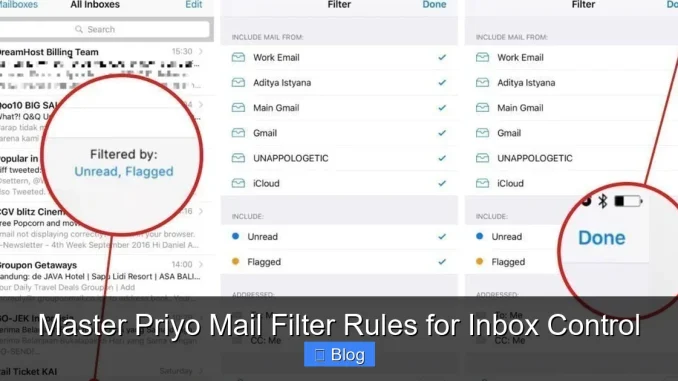
Struggling with a cluttered inbox? Priyo Mail filter rules can help you automate email organization, reduce distractions, and save time. By setting up smart filters, you can automatically sort, label, archive, or delete messages based on sender, subject, keywords, and more.
Key Takeaways
- Automate email sorting: Use filter rules to automatically move emails to specific folders or labels, reducing manual effort.
- Block spam and unwanted senders: Create filters to detect and delete or archive promotional or suspicious emails instantly.
- Prioritize important messages: Set up rules to highlight or forward critical emails from key contacts or projects.
- Save time daily: Reduce inbox clutter and focus on what matters by letting filters handle routine email tasks.
- Customize for your workflow: Tailor filter rules to match your personal or professional email habits for maximum efficiency.
- Combine conditions for precision: Use multiple criteria like sender, subject, and keywords to create highly accurate filters.
- Test and refine regularly: Review and adjust your filter rules periodically to ensure they stay effective as your email patterns evolve.
📑 Table of Contents
Why Inbox Control Matters More Than Ever
Let’s be honest—email overload is real. Between work messages, newsletters, promotional blasts, and personal updates, the average person receives over 100 emails a day. Without a system in place, your inbox can quickly become a digital dumping ground, making it hard to focus, prioritize, or even find important messages when you need them.
This is where Priyo Mail filter rules come in. Think of them as your personal email assistant—quietly working in the background to sort, label, and manage your messages so you don’t have to. Whether you’re a busy professional, a student juggling multiple projects, or just someone who values a clean digital space, mastering filter rules can transform your email experience from chaotic to calm.
What Are Priyo Mail Filter Rules?
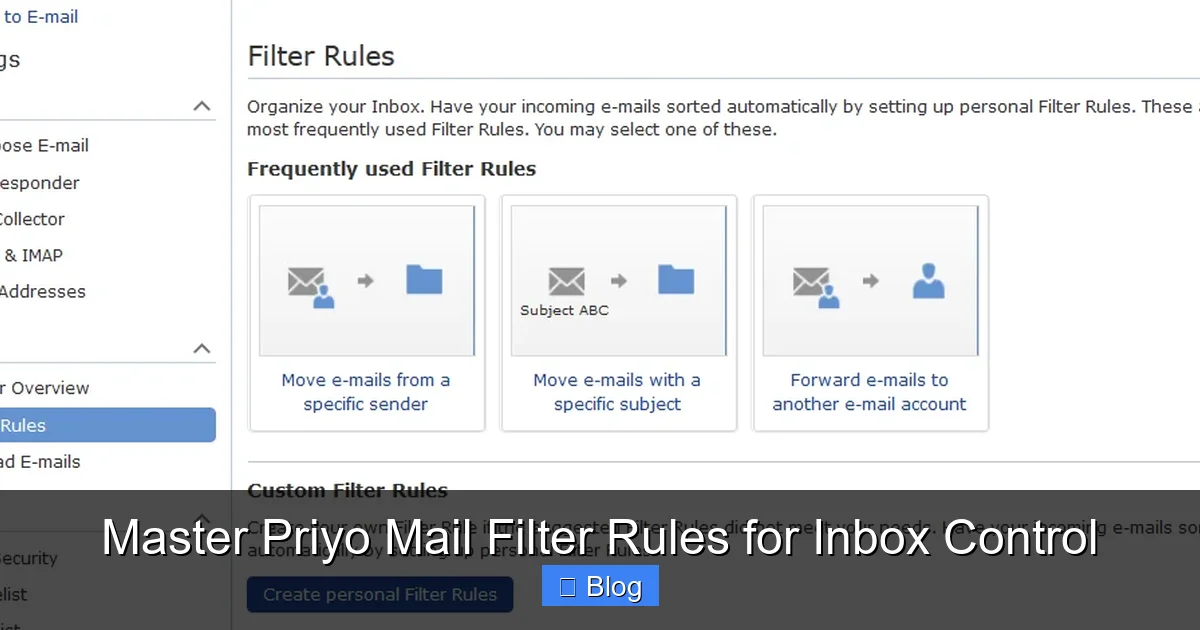
Priyo Mail filter rules are automated instructions you set up to tell your email client how to handle incoming messages. These rules scan each new email and apply actions based on conditions you define—like who sent it, what the subject line says, or if it contains certain keywords.
Visual guide about Master Priyo Mail Filter Rules for Inbox Control
Image source: img.ui-portal.de
How Filter Rules Work
When an email arrives, Priyo Mail checks it against your active filter rules. If the email matches a rule’s conditions, the system automatically performs the assigned action. For example, you could set a rule that says: “If the sender is [email protected], move it to the ‘Newsletters’ folder and mark as read.” From that point on, every email from that address will be handled without you lifting a finger.
Common Use Cases
- Moving work emails to a “Work” folder
- Archiving receipts and order confirmations
- Blocking emails from known spam domains
- Forwarding urgent messages to a colleague
- Labeling emails from your manager with a “High Priority” tag
The best part? Once set up, these rules run silently and instantly—no apps to open, no buttons to click. It’s like having a 24/7 email manager who never takes a coffee break.
Setting Up Your First Filter Rule
Getting started with Priyo Mail filter rules is easier than you might think. You don’t need to be a tech expert—just follow these simple steps to create your first rule.
Visual guide about Master Priyo Mail Filter Rules for Inbox Control
Image source: clean.email
Step 1: Access the Filter Settings
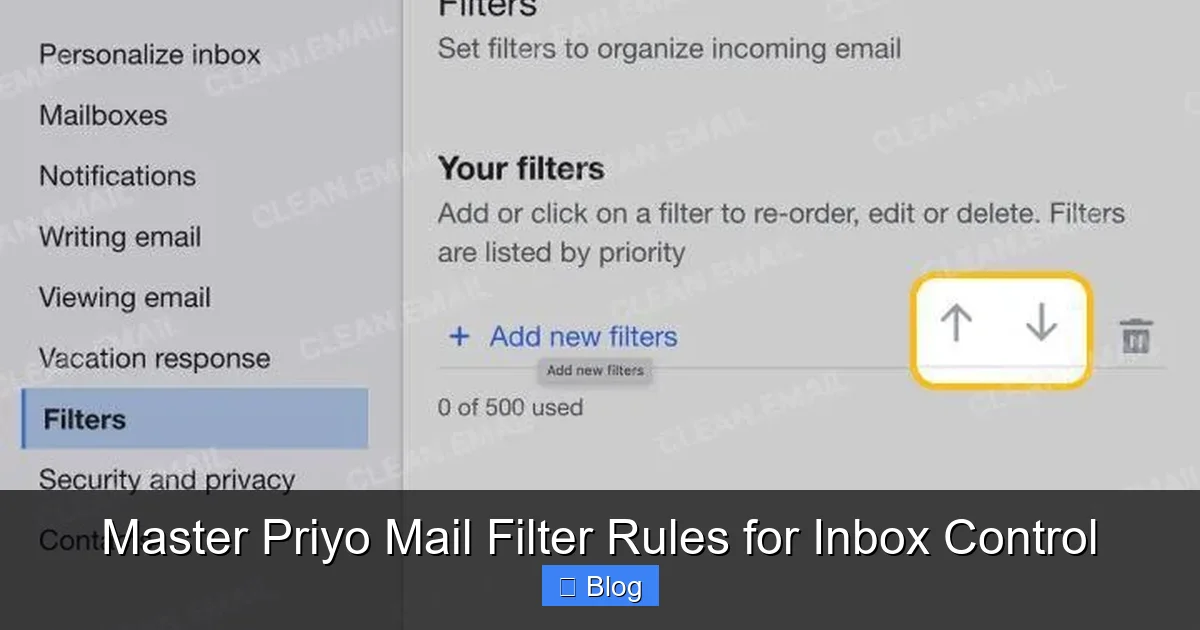
Log into your Priyo Mail account and navigate to the settings menu. Look for an option labeled “Filters,” “Rules,” or “Automations.” This is where you’ll manage all your filter rules. If you can’t find it, check under “Advanced Settings” or “Email Management.”
Step 2: Define the Conditions
Next, specify when the rule should trigger. You can base this on:
- Sender: Match emails from a specific email address or domain (e.g., @company.com)
- Subject: Look for keywords like “Invoice,” “Meeting,” or “Urgent”
- Body content: Scan the email body for phrases like “unsubscribe” or “limited time offer”
- Recipients: Filter based on whether you’re in the To, CC, or BCC field
For example, you might set a condition: “If the sender contains ‘[email protected]’ AND the subject contains ‘statement,’ then apply the following action.”
Step 3: Choose the Action
Now decide what should happen when the rule is triggered. Common actions include:
- Move to a specific folder or label
- Mark as read or unread
- Delete the email
- Forward to another address
- Apply a color label or priority tag
- Skip the inbox (archive directly)
Let’s say you want all emails from your project manager to go straight to a “Work – Urgent” folder and be marked as high priority. You’d set the action to “Move to folder: Work – Urgent” and “Apply label: High Priority.”
Step 4: Save and Test
Once you’ve configured your rule, save it and send yourself a test email that matches the conditions. Check if it behaves as expected. If not, tweak the conditions or actions and test again. It’s normal to refine rules a few times before they work perfectly.
Advanced Filtering Techniques
Once you’ve mastered the basics, you can level up your email game with more advanced filtering strategies. These techniques help you handle complex email scenarios and fine-tune your inbox control.
Visual guide about Master Priyo Mail Filter Rules for Inbox Control
Image source: i.ytimg.com
Using Multiple Conditions
You can combine several conditions to make your filters more precise. For instance, you might want to filter emails that are:
- From a specific domain (e.g., @client.com)
- Sent to you directly (not CC’d)
- And contain the word “deadline” in the subject
This ensures only truly important client emails get special treatment, while group updates or casual messages are handled differently.
Excluding Certain Emails
Sometimes, you want to filter most emails from a sender—but not all. For example, you might want to archive most newsletters from a brand, but keep promotional offers. Use the “Does not contain” condition to exclude specific keywords. Set a rule like: “If sender is [email protected] AND subject does NOT contain ‘50% OFF,’ then archive.”
Time-Based Filters
Some email clients allow time-based conditions. While Priyo Mail may not support full scheduling, you can simulate this by creating rules that activate based on email metadata. For example, filter emails received after 6 PM as “After Hours” and move them to a separate folder for review the next morning.
Forwarding and Delegation
If you’re out of office or working with a team, use filters to automatically forward certain emails. Set a rule to forward all emails with “HR” in the subject to your assistant, or route customer support queries to your team lead.
Common Mistakes to Avoid
Even the best intentions can go wrong if your filter rules aren’t set up carefully. Here are some common pitfalls and how to avoid them.
Over-Filtering Important Emails
It’s easy to get carried away and create rules that are too broad. For example, filtering all emails with “meeting” in the subject might accidentally archive a critical team update. Always test your rules and review filtered emails periodically to ensure nothing important is slipping through.
Forgetting to Update Rules
Your email habits change over time. A sender you once filtered aggressively might now be a key contact. Set a calendar reminder every three months to review and update your filter rules. Remove outdated ones and add new ones as needed.
Ignoring False Positives
Sometimes, a legitimate email gets caught in a filter meant for spam. To prevent this, avoid using overly broad keywords like “free” or “offer” unless combined with other conditions. Also, consider setting up a “Review Later” folder for borderline cases instead of deleting them outright.
Not Backing Up Rules
If you switch devices or accounts, you could lose your carefully crafted filter rules. Export or document your rules regularly. Some email platforms allow you to export filter settings as a file—take advantage of this feature.
Real-Life Examples of Effective Filter Rules
Let’s look at a few practical examples of how real users apply Priyo Mail filter rules to stay organized.
Example 1: The Freelancer
Sarah is a freelance designer who juggles multiple clients. She sets up the following rules:
- Emails from @clientA.com → Move to “Client A” folder, apply “Active Project” label
- Emails with “invoice” in subject → Move to “Finance” folder, mark as important
- Emails from @newsletter.com → Archive immediately
- Emails sent after 7 PM → Move to “After Hours” folder
Result: Sarah spends less time sorting emails and more time designing.
Example 2: The Student
Jamal is a college student managing classes, part-time work, and personal life. His filters include:
- Emails from @university.edu → Move to “School” folder, mark as unread
- Emails with “assignment” or “due date” → Apply “Urgent” label
- Emails from @store.com → Delete (he’s tired of促销 emails)
- Emails from family → Apply “Personal” label, never archive
Result: Jamal never misses a deadline and keeps his inbox under 50 emails.
Example 3: The Small Business Owner
Maria runs a local bakery. She uses filters to manage customer inquiries and orders:
- Emails with “order” in subject → Forward to her assistant, apply “Order” label
- Emails from @gmail.com with “complaint” → Move to “Customer Service” folder, mark as high priority
- Emails from @supplier.com → Move to “Suppliers” folder
- Emails with “unsubscribe” in body → Delete
Result: Maria responds faster to customers and keeps her team aligned.
Tips for Maintaining a Healthy Inbox
Filter rules are powerful, but they work best as part of a broader email hygiene strategy. Here are a few tips to keep your inbox in top shape.
Unsubscribe Regularly
Even with filters, unwanted emails take up space and processing power. Every month, spend 10 minutes unsubscribing from newsletters you no longer read. Use tools like Unroll.me or Priyo Mail’s built-in unsubscribe feature to make this easier.
Use Labels and Folders Wisely
Don’t create too many folders—this can make navigation harder. Stick to 5–7 main categories (e.g., Work, Personal, Finance, Projects, Archive) and use labels for subcategories.
Schedule Email Time
Instead of checking email all day, set specific times to review your inbox. This reduces distractions and helps you focus on deep work. Use your filter rules to ensure only urgent messages break through.
Archive, Don’t Delete
When in doubt, archive instead of deleting. Archived emails are out of sight but still searchable if you need them later. This reduces clutter without the risk of losing important information.
Conclusion
Mastering Priyo Mail filter rules isn’t just about tidying up your inbox—it’s about reclaiming your time, focus, and peace of mind. With the right setup, your email can work for you, not against you. From automatically sorting newsletters to highlighting urgent messages, filter rules turn a chaotic inbox into a streamlined communication hub.
Start small. Create one or two rules this week, test them, and build from there. Over time, you’ll develop a system that fits your unique workflow. Remember, the goal isn’t perfection—it’s progress. Every filter you set up is a step toward a calmer, more productive digital life.
So go ahead—take control. Your inbox (and your future self) will thank you.
Frequently Asked Questions
What are Priyo Mail filter rules?
Priyo Mail filter rules are automated settings that tell your email client how to handle incoming messages based on conditions like sender, subject, or keywords. They help sort, label, archive, or delete emails automatically.
Can I create multiple filter rules in Priyo Mail?
Yes, you can create as many filter rules as needed. Just make sure they don’t conflict with each other. Test each rule to ensure it works as intended.
Will filter rules affect emails I’ve already received?
No, filter rules only apply to new incoming emails. To organize old messages, you’ll need to manually sort them or use search and bulk actions.
Can I stop a filter rule once it’s active?
Absolutely. You can edit, pause, or delete any filter rule at any time from the settings menu. Changes take effect immediately.
Do filter rules work on mobile devices?
Yes, once set up on your account, filter rules work across all devices where you access Priyo Mail, including smartphones and tablets.
Are filter rules secure?
Yes, filter rules operate within your email account and don’t share your data externally. They’re a safe way to automate email management without compromising privacy.
Leave a Reply